The Laptop: Otherwise
A speculative design project questioning the laptop as a cultural object of productivity, efficiency, and standardized behavior.
November 2025 · Self-initiated project
Methods/Tools: Speculative Design, Blender Prototyping
PART I: Ideology Disguised as Neutrality
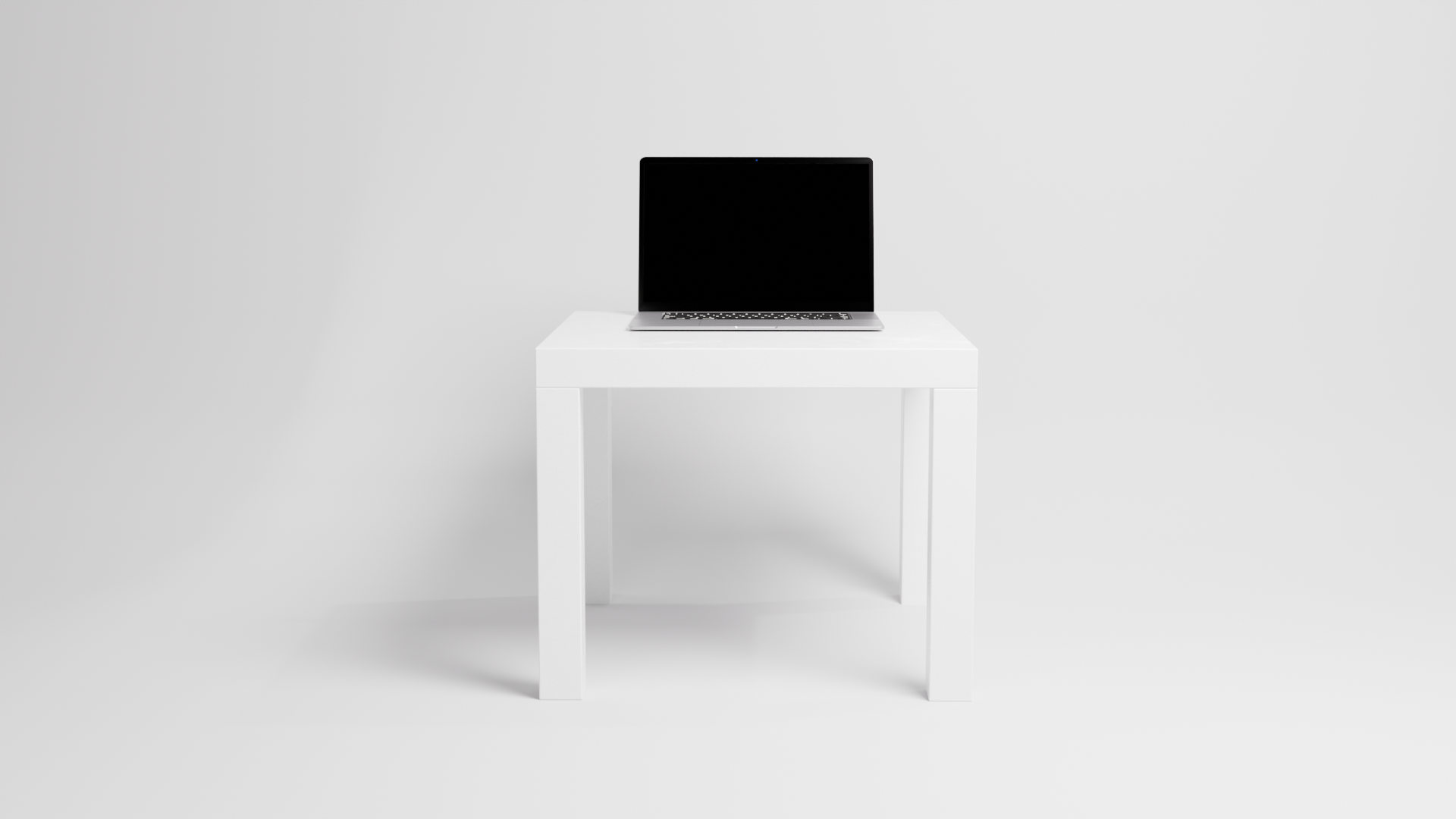
A laptop. An IKEA table. A white background.
Both objects present themselves as neutral: minimal, efficient, and unobtrusive. They don’t seem to communicate a clear position. They simply appear as useful objects, ready to be placed anywhere and used in different situations. But this neutrality does not mean that they are free from ideology. Instead, their ideology is built into their form so quietly that it becomes part of everyday life. In this case, ideology does not appear as a visible message or political statement. It appears as a set of assumptions about how life should be organized: flexible, mobile, productive, and always ready to continue. The laptop promises work from anywhere. The table can be moved, rearranged, and adapted to almost any space. Their generic form allows them to enter different contexts without resistance: home, office, café, studio, bedroom. This is what makes their ideology effective. It is not announced. It is embedded in their design, in their usefulness, and in the everyday situations in which they appear. Because of that, it becomes difficult to notice. They do not need to persuade us. They simply become normal.
At the same time, this openness also carries a specific logic. The laptop is designed around constant availability and productivity. The table supports temporary setups, flexible routines, and a life organized around movement and adaptation. They do not openly demand anything, but they make certain behaviors easier, more expected, and more normal.
In this sense, the laptop and the table are not just passive tools. They are everyday structures that shape how we work, behave, rest, and move through space. The project starts from this observation and asks what happens when these familiar objects are no longer treated as neutral, but as carriers of social and cultural expectations.
What if the embedded ideology became visible?
PART II — (IN)VISIBLE CONTROL
You open the laptop. The screen lights up. A browser opens automatically. A notification appears. An email waits for a response. A document suggests that you continue where you left off. A calendar reminds you of what comes next. You have not decided anything yet. And still, you are already acting. Every button placement, every default setting, every notification, and every suggested action is part of a structure that was designed before you ever touched the object. What feels like the beginning of your own action is already shaped by someone else’s decisions. You do not start from an empty space. You respond to an environment that has already been arranged.
This part draws on Michel Foucault’s understanding of power as something that doesn’t only prohibit, but also structures possible actions. Power, in this sense, does not simply say “no”. It organizes the field in which choices can appear. Applied to the laptop, this means looking at it not as a neutral medium, but as a structured environment. Its buttons, defaults, layouts, notifications, and sequences shape what becomes visible, available, expected, or easy to do. The laptop does not force a single action, but it defines and structures the conditions in which action takes place.
Byung-Chul Han’s writing on self-optimization and internalized control extends this perspective. For Han, control is often no longer experienced as something external. It appears as motivation, productivity, freedom, and the desire to keep going. The user does not necessarily feel controlled. They feel enabled. They feel efficient. They feel like they are choosing. Seen this way, the structure described through Foucault becomes internalized: the user participates in it voluntarily, because it feels like freedom.
This part of the project makes the internalized control of the laptop visible by reducing the user’s field of action. What is usually hidden in defaults, suggestions, and habits becomes physical: the object no longer only guides behavior, but visibly limits it.
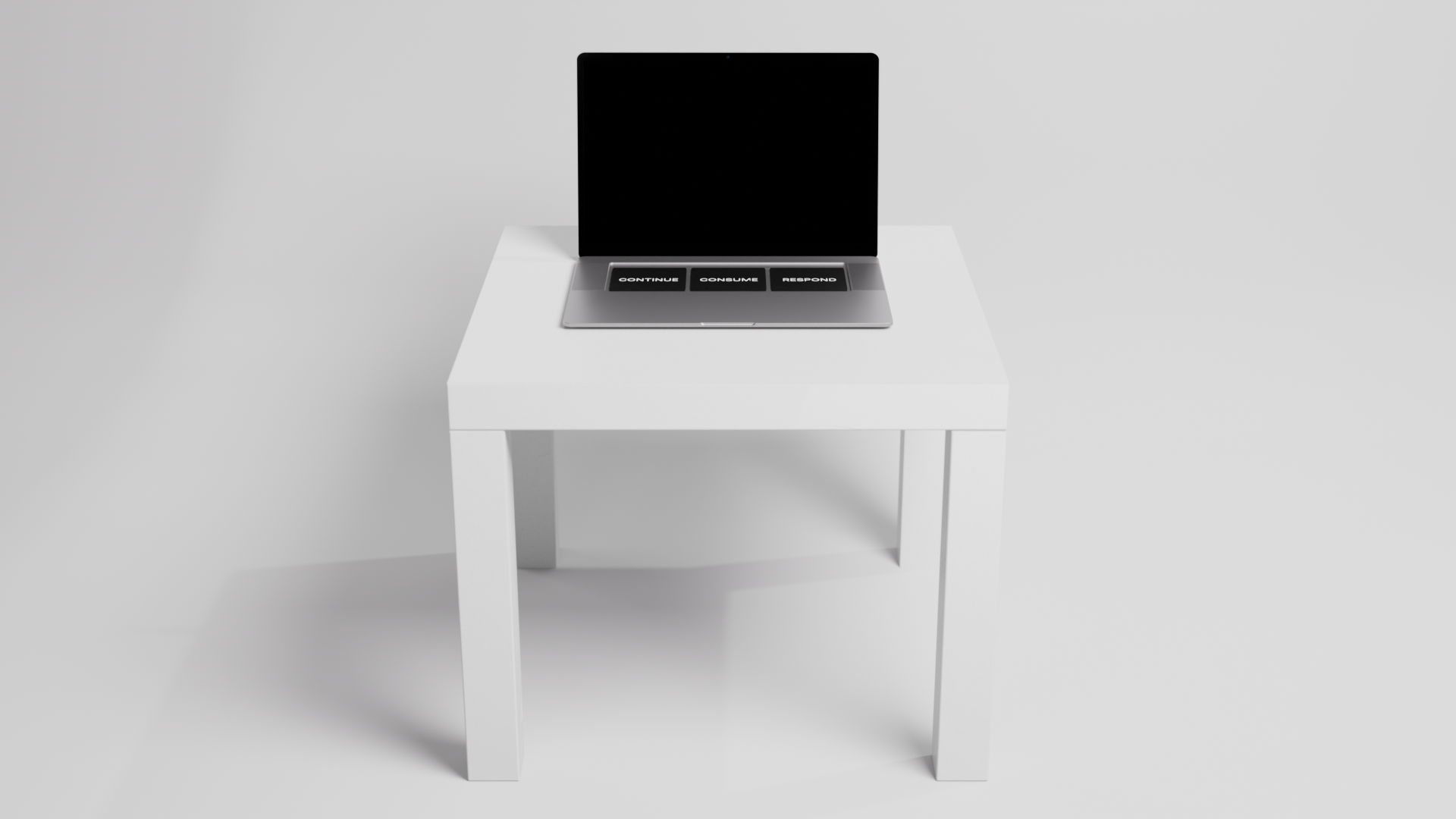
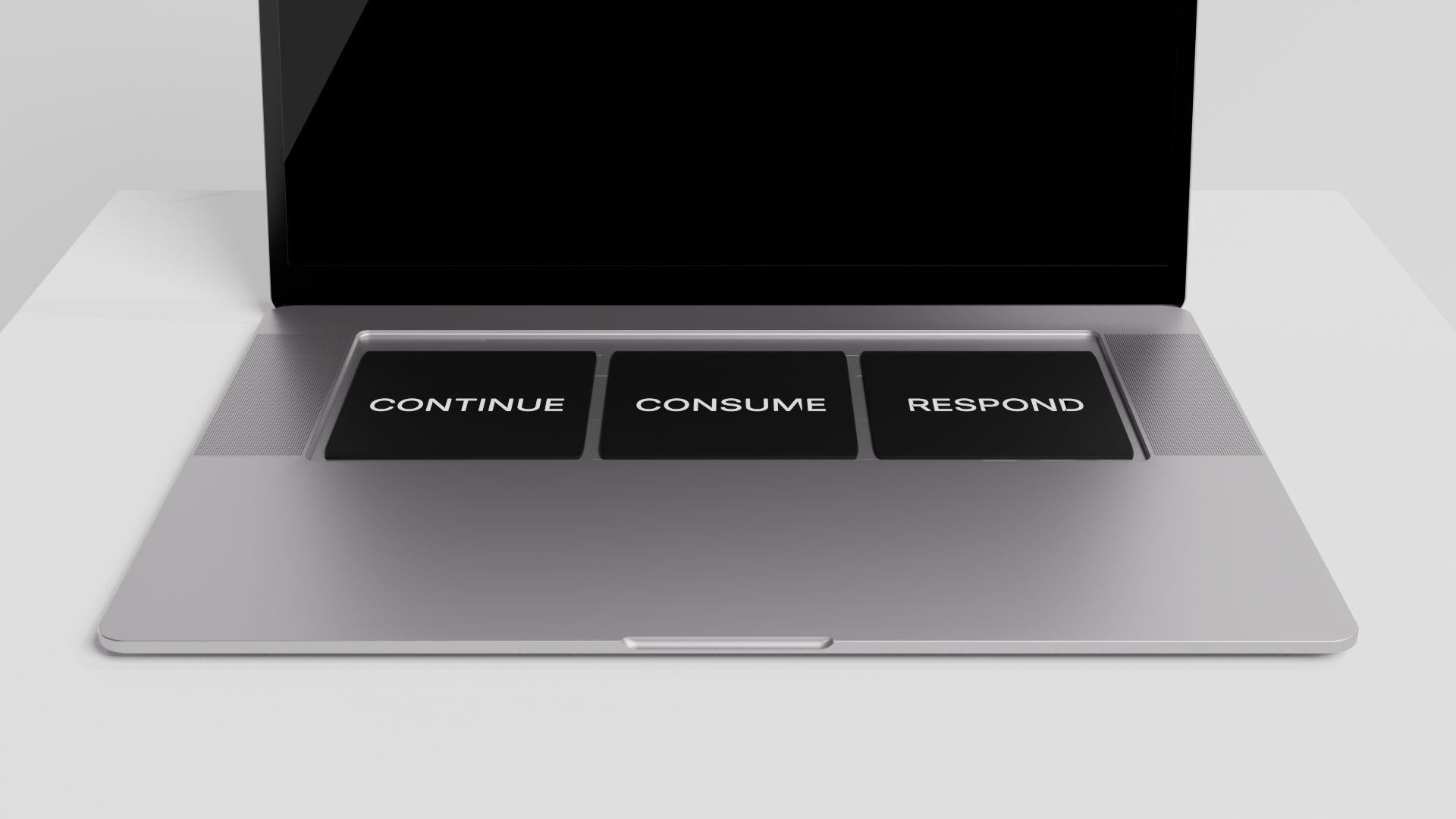
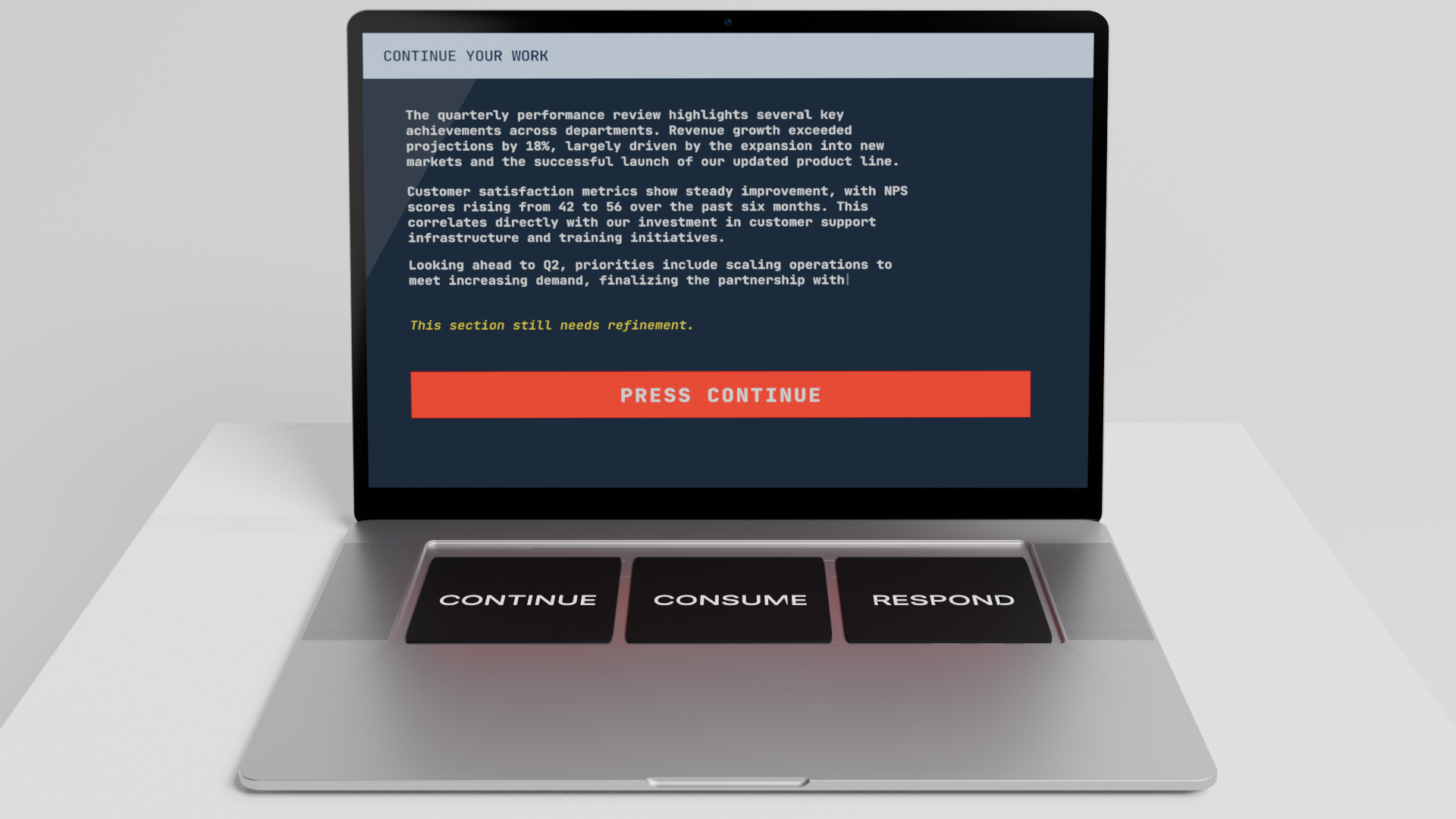
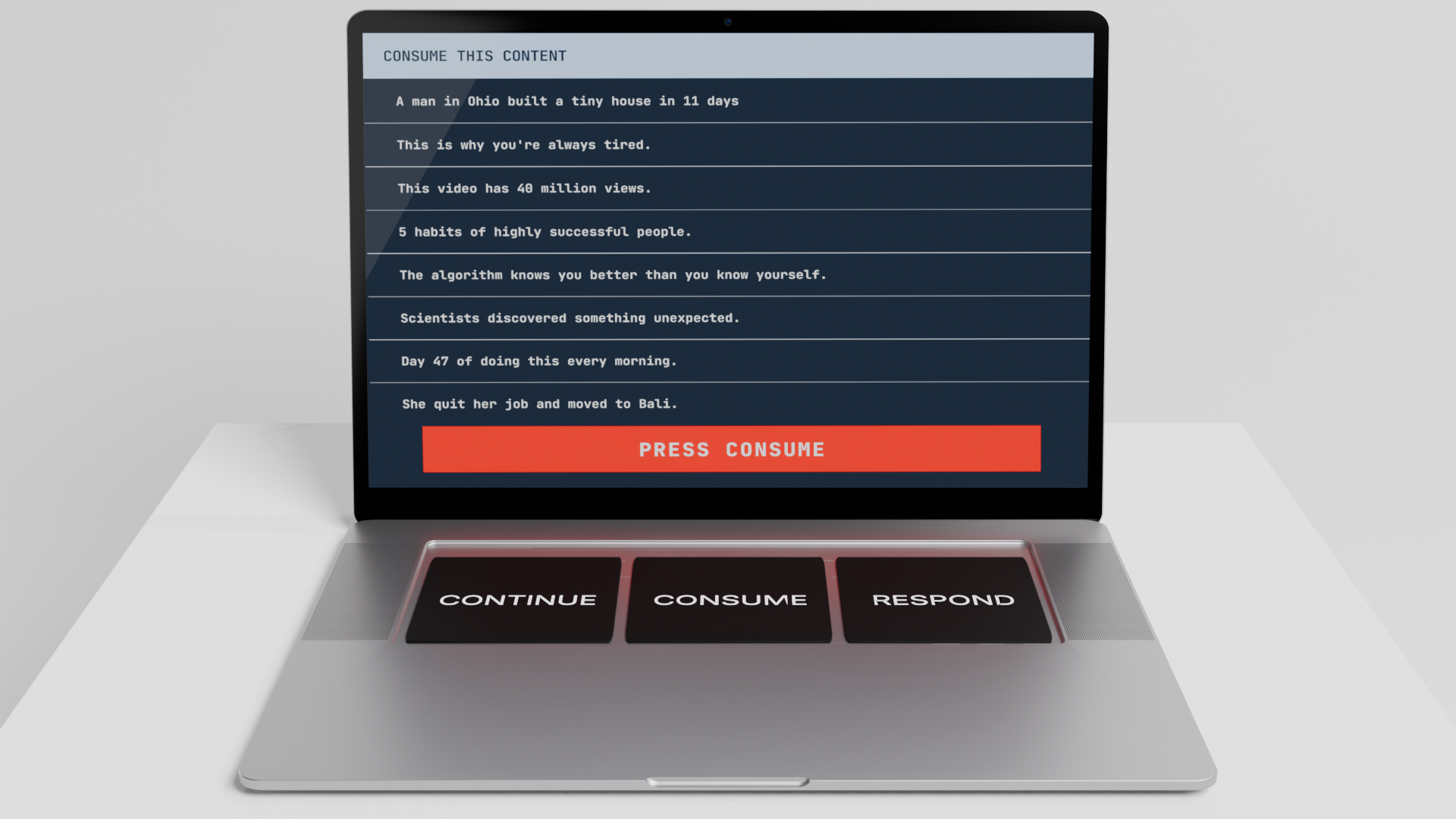
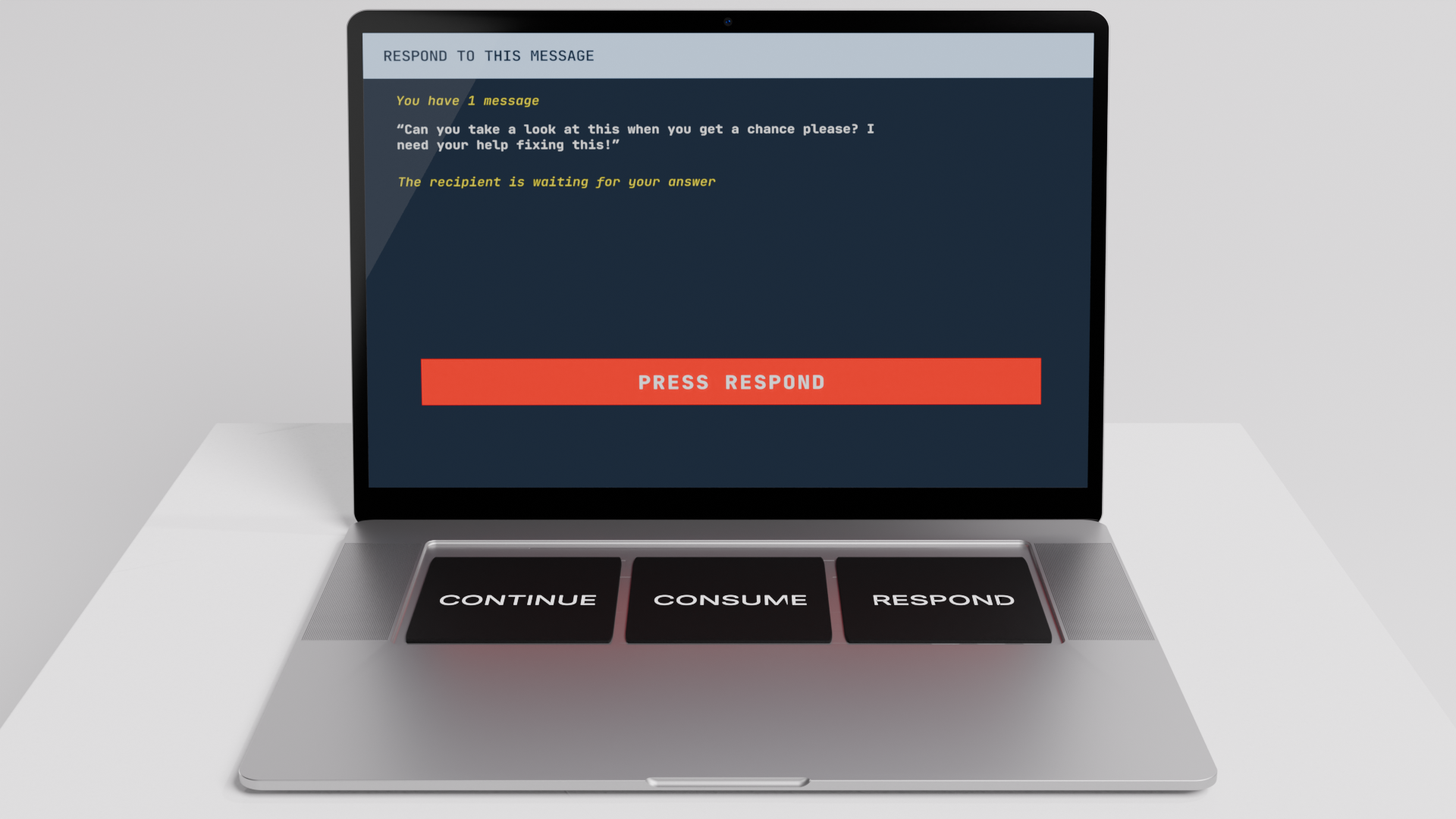
The keyboard of this laptop is reduced to three keys: CONTINUE, CONSUME, RESPOND. Each key leads to a different screen, but the interaction always follows the same logic. The user does not write, search, create, interrupt, or define their own path. They only react to what is already presented.
The laptop still offers interaction, but only within a very limited field of action. There is no mouse, no trackpad, and no visible power button. The user can only continue a task, consume content, or respond to a request/message. These actions appear active, but they are already framed by the system. The user becomes less of an author and more of a participant inside a structure that has already decided what kind of action is possible.
This connects back to Foucault’s idea of power as something that organizes the field of possible actions. The laptop does not need to say “no” directly. It simply reduces the space in which choice can appear. You are still acting, but only inside a structure that was defined before you began.
At the same time, the project connects back to Byung-Chul Han's concept of internalized control, introduced earlier. The user is not forced from the outside. They continue, consume, and respond voluntarily. The interaction feels like participation, productivity, or entertainment, but it still follows the rhythm of the system. In this sense, the user becomes an active but passive consumer: still pressing, choosing, and responding, but only within the limits already given.
The project also reflects a current shift in digital interaction. More and more, interfaces try to reduce friction by deciding in advance what might be useful, relevant, or necessary. They recommend, sort, remind, autocomplete, and continue for us. This can feel helpful, but it also changes the role of the user. Instead of starting actions freely, the user increasingly reacts to what has already been prepared.
The project changes the laptop by exaggerating its existing logic. It does not claim that laptops literally only allow these three actions. Instead, it reduces a complex device to three dominant modes of interaction that already shape much of everyday digital life. What is normally spread across interfaces, notifications, defaults, feeds, and suggestions becomes direct, physical, and difficult to ignore.
What if the embedded ideology were completely rejected?
PART III: AFTER PRODUCTIVITY: THE EPICUREAN LAPTOP
A different ideology. A different object.
The Epicurean Laptop begins with rejection. It rejects the logic of productivity. It asks what a laptop could become if it was no longer designed around efficiency, speed, and output, but around rest, comfort, and enoughness. The project is based on three ideas from Epicurus, the ancient Greek philosopher who understood happiness not as excess or achievement, but as a life free from unnecessary disturbance.
The first is ataraxia, a state of calmness and freedom from mental disturbance. For Epicurus, this was one of the highest forms of happiness. A good life was not about constant expansion, achievement, or excess, but about reaching a state in which the mind is no longer pulled in every direction. In this sense, ataraxia stands almost opposite to the way contemporary life and contemporary devices are organized. The modern laptop keeps attention open, available, and interruptible. The Epicurean Laptop tries to do the opposite.
The second idea is aponia, the absence of bodily pain. Epicurus did not separate the mind from the body. A calm mind needs a body that is not tense, exhausted, or in discomfort. Rest is not only mental. It is also physical.
The third idea is the Garden. Epicurus taught in a garden outside Athens, away from the center of political and public life. The Garden was not only a place, but a way of living. It stood for withdrawal, friendship, simplicity, and a life organized around what is actually needed.
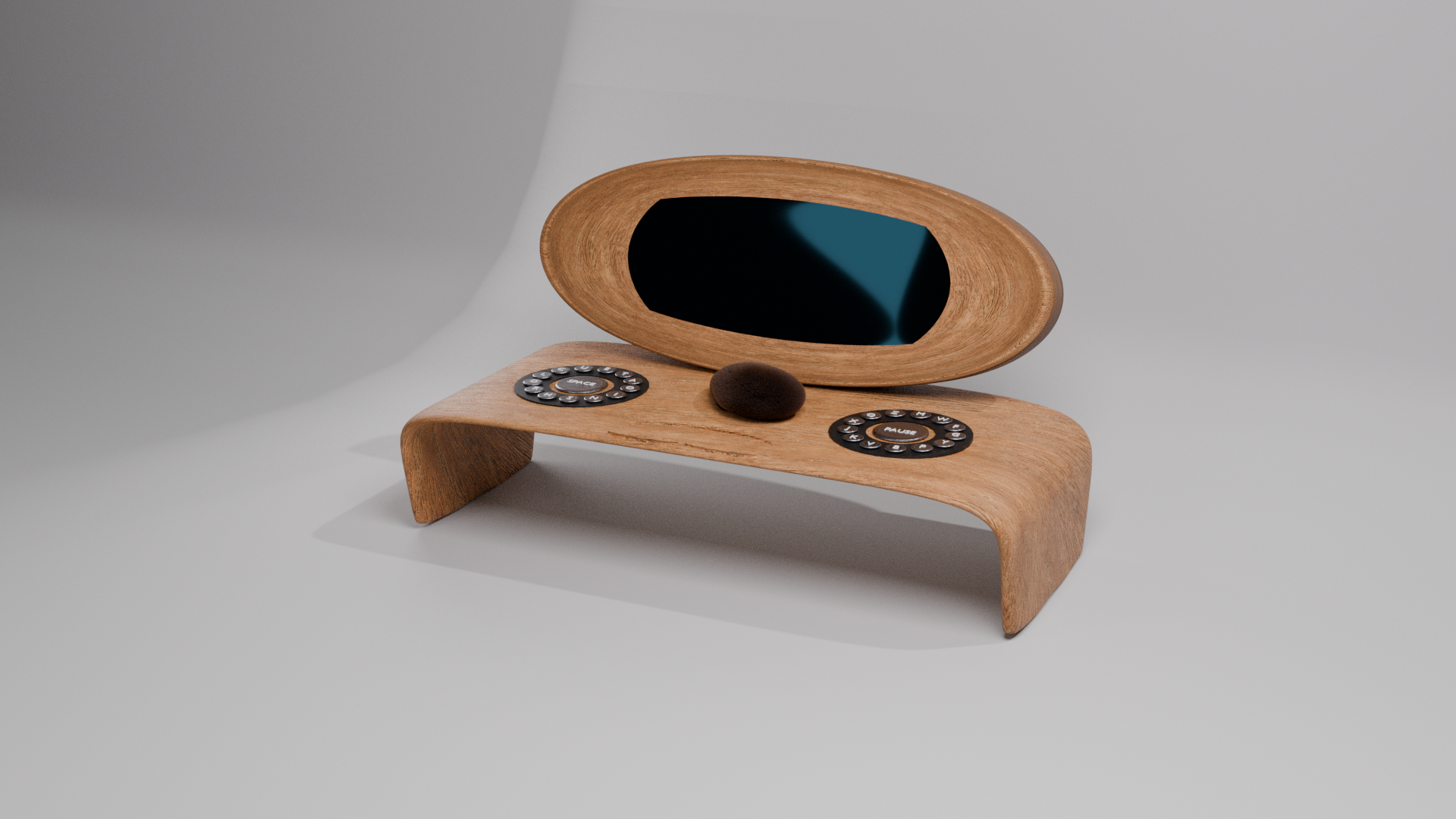
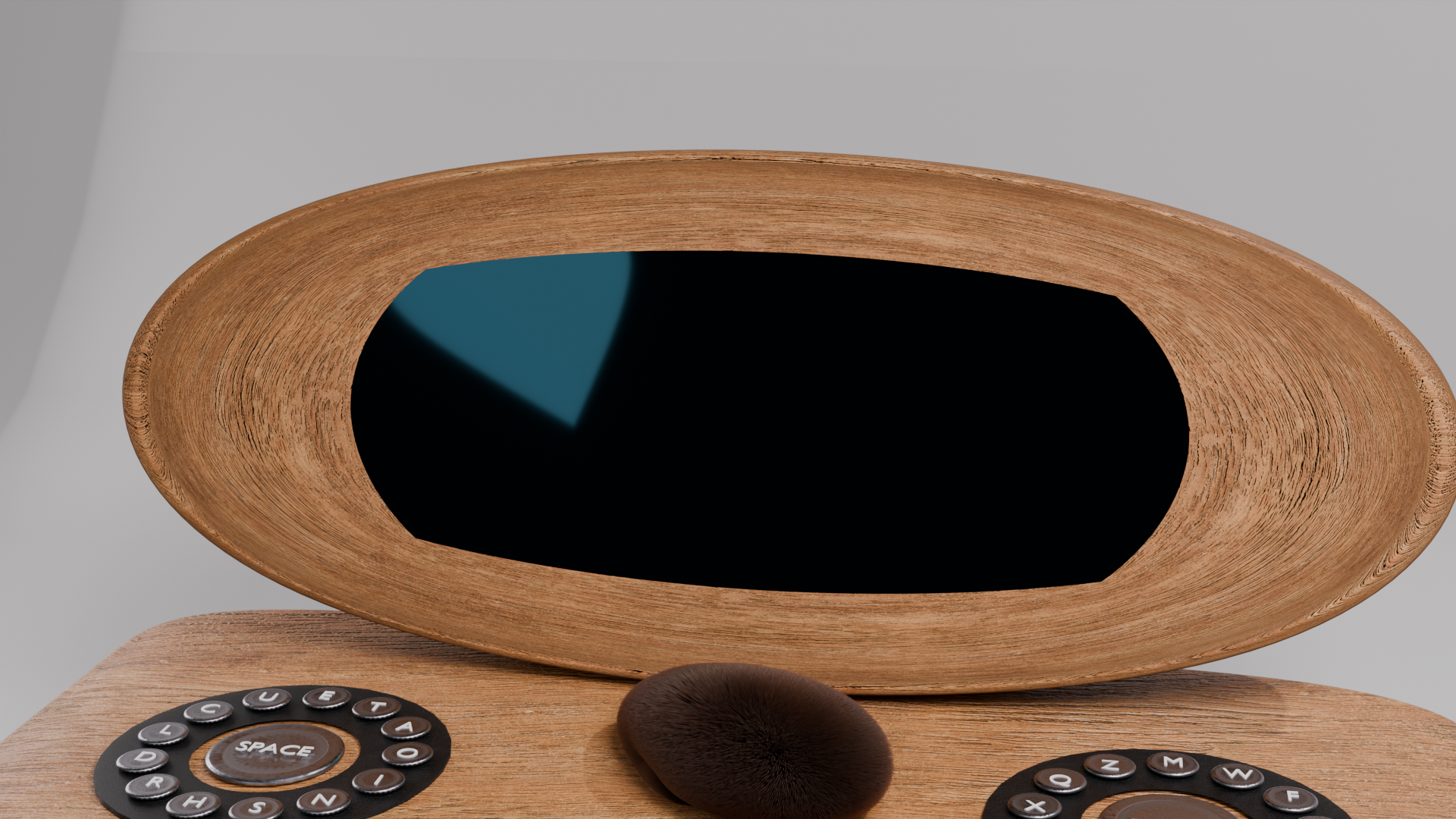
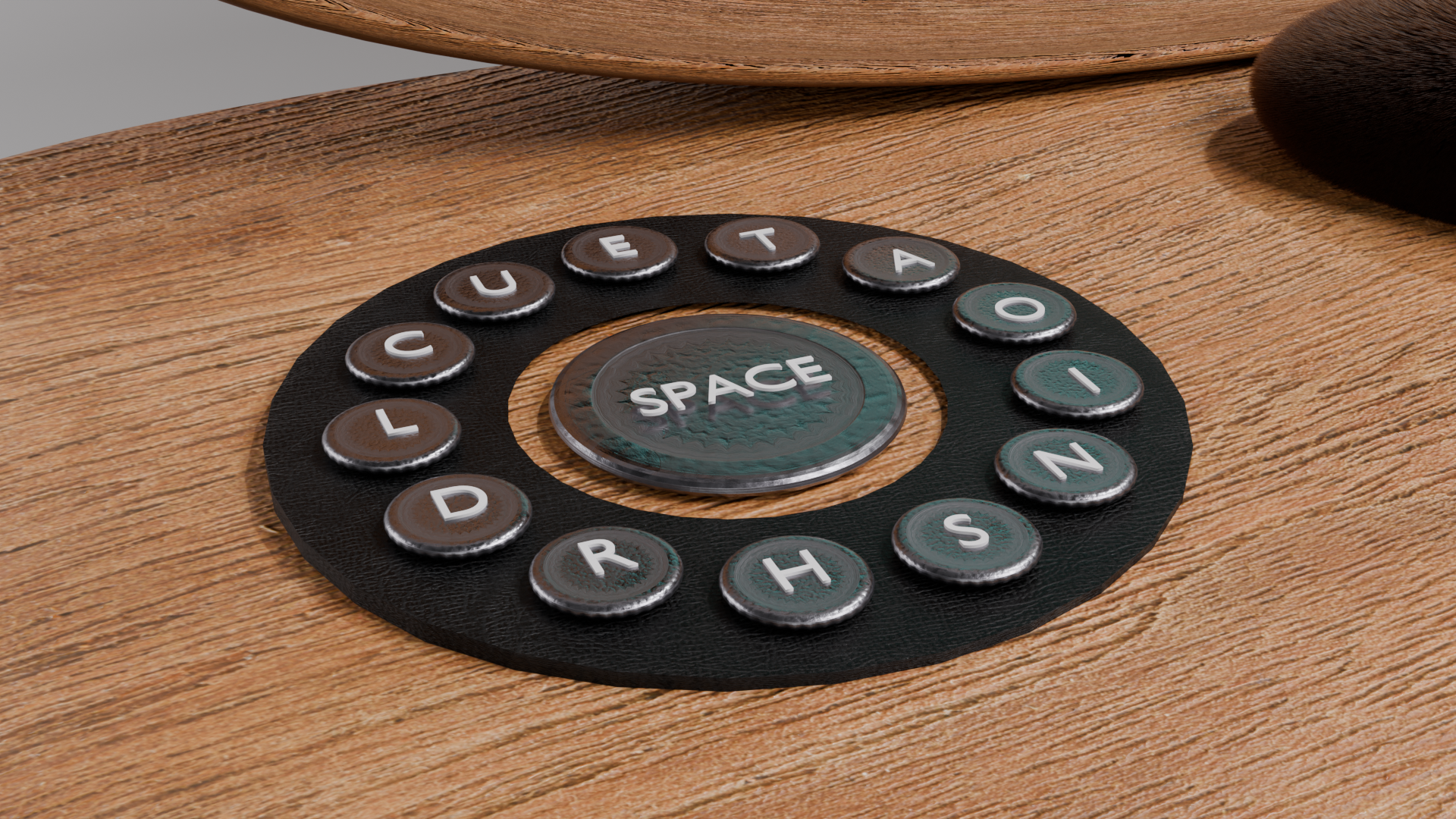
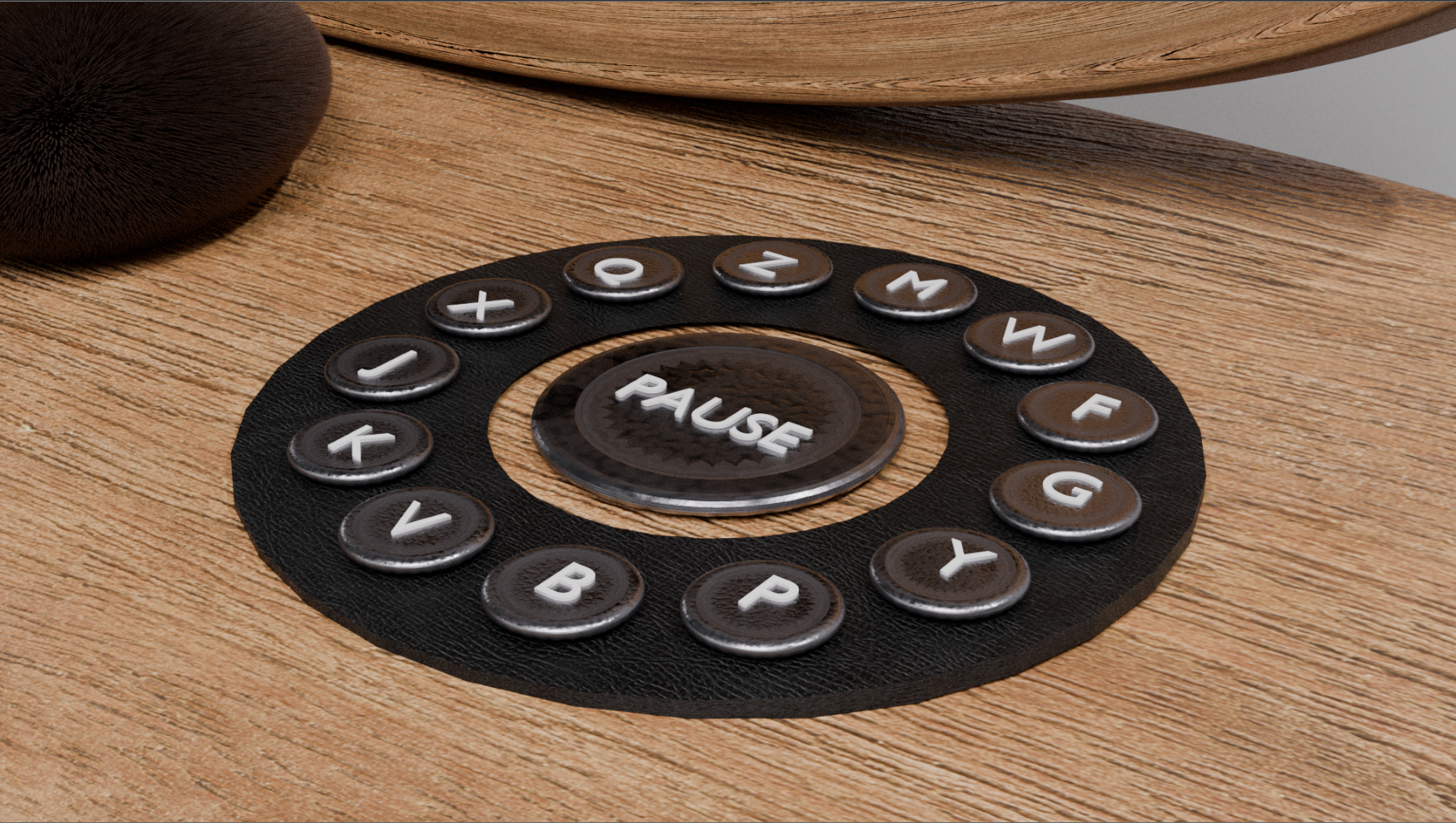
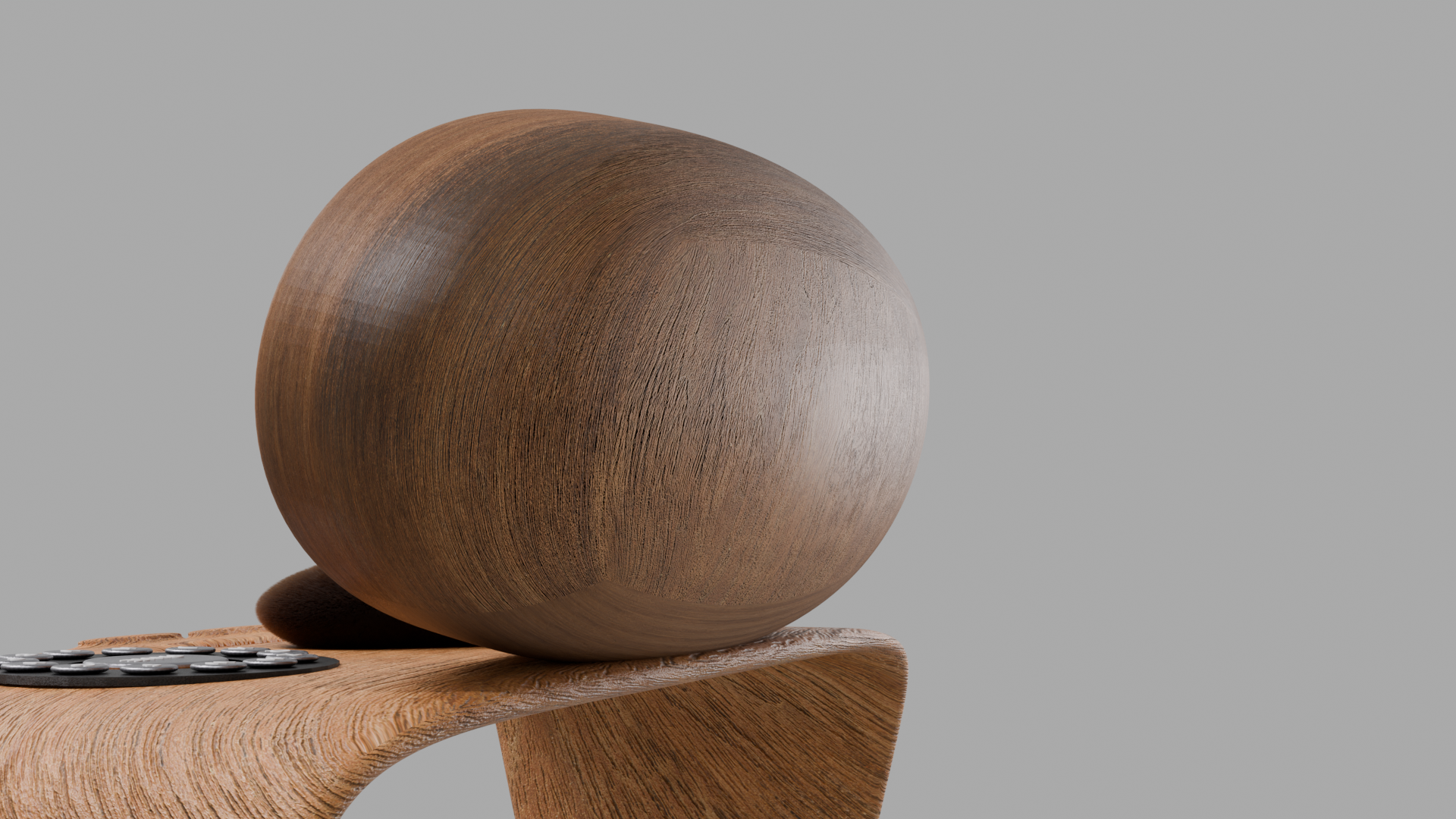
From these three ideas, the design of the laptop follows. The object stands on short wooden legs. It does not travel. It does not fit into a bag. It belongs somewhere and stays there. Mobility, one of the central promises of the modern laptop, is rejected entirely. You do not take this device with you. You come to it, as you would come to a garden, a place of retreat, or a room of your own. To use it, you sit on the floor. This changes the relationship between body and device. Instead of adapting yourself to the height of a desk, you can shift your position, sit differently, lean, pause, or move closer and further away. The device does not demand one fixed productive posture. It allows the body to search for comfort. The healthiest posture is not one perfect position, but the possibility of many positions. The surface is made of wood. It is warm, natural, slightly rough, and changes with time. It becomes darker where the hands rest most. It carries traces of use instead of hiding them. The buttons are made of polished stone and rest on leather. These materials are not chosen because they are efficient. They are chosen because they slow the object down and make it feel less like a machine for output.
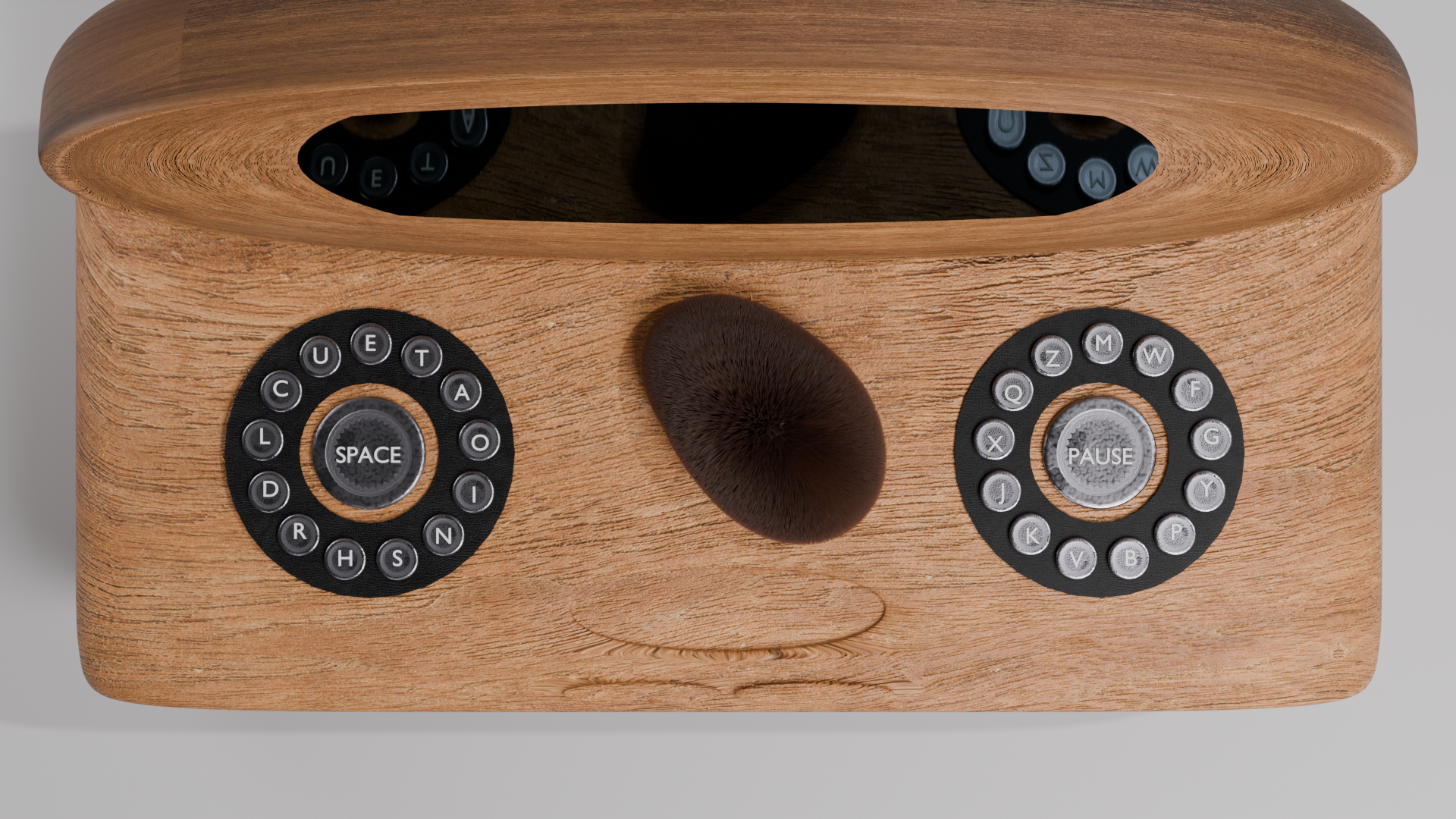
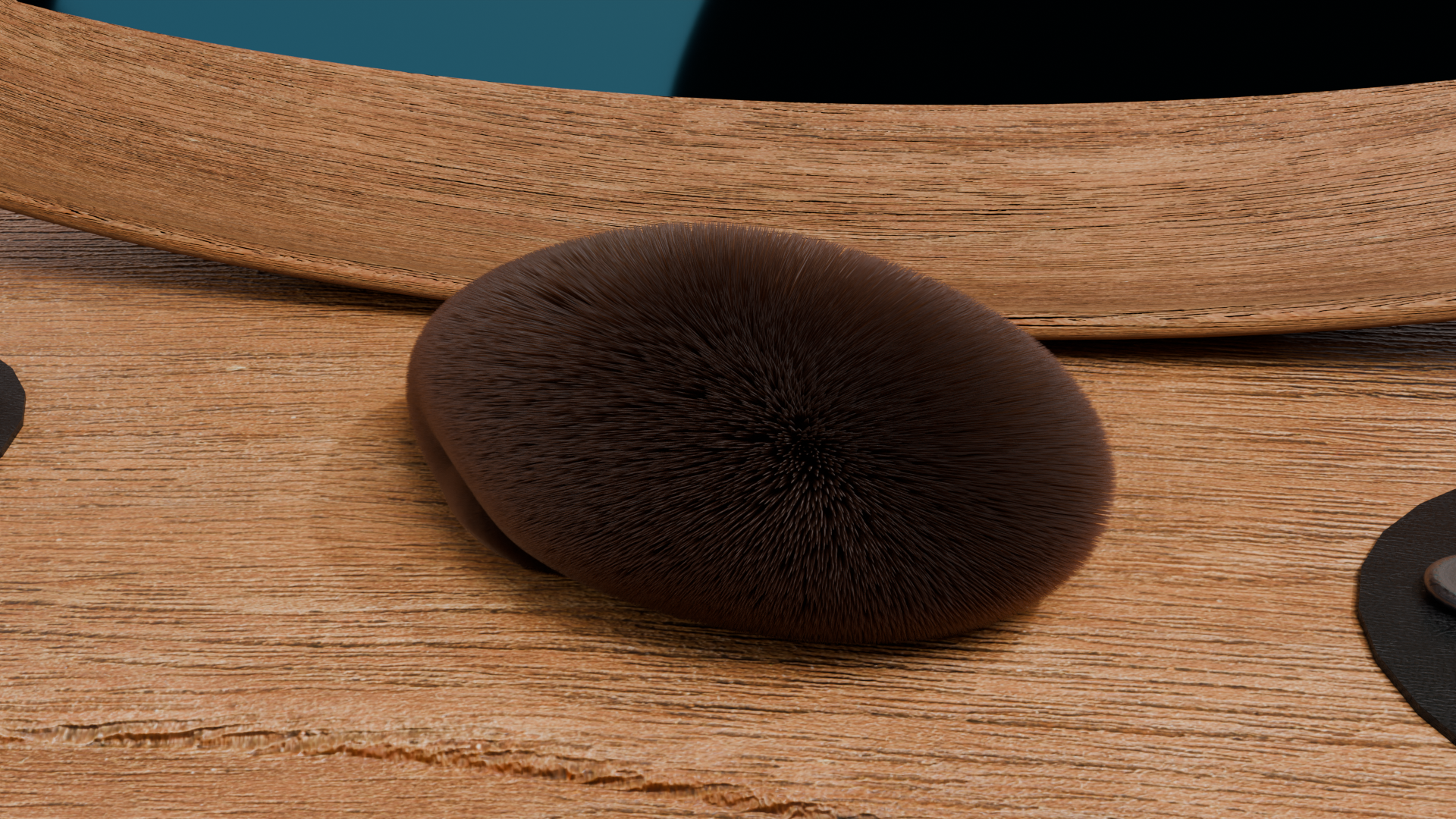
At the center of the laptop, between two circular clusters of keys, sits a felt-covered sphere for the hand to rest on. It does not measure numbers, scores, dashboards, or performance data. Instead, passive sensors read simple bodily signals such as heart rhythm, skin conductivity, and breathing rhythm. When you are tense, the sphere becomes warmer. When you become still, it becomes still. The sphere relates to aponia. It gently registers the state of the body and reminds the user that the body matters. You cannot think clearly when your body is tense. You cannot rest when your nervous system is in alarm. But the sphere does not ask you to manage yourself. It does not tell you to improve. It simply responds and makes the state of the body present.
The keyboard is divided into two circular clusters, one for each index finger. Only two fingers type. This is not an attempt to be efficient. It is the opposite. Writing becomes slower. Each letter becomes a conscious action. Each word takes time, attention, and intention. The letters are arranged by frequency in English, not alphabetically. The layout does not follow convention. It makes every press deliberate. The user has to select each letter individually and becomes aware of every action the device requires. Typing is slower than on a normal keyboard, but that slowness is the point. In the center of the key clusters are two large buttons: SPACE on the left and PAUSE on the right. The space button separates words, as a normal space button does. The pause button is pressed when the user needs a moment of silence. It allows the user to return to ataraxia, to calmness, before continuing.
There are no notifications. They are not disabled. They are structurally absent. There is no browsing history. Each session begins without memory of the last. The device does not accumulate tasks, tabs, reminders, or unfinished obligations. It only remembers what is necessary for care and connection, such as contacts of friends and family. It does not remember what you did in previous sessions. The only thing that matters is now. It does not ask you to continue where you left off. It takes two minutes to turn on. Not because it is slow by accident, but because it refuses instant availability. These two minutes are not loading time. They are arrival. They give the user time to sit down, breathe, and enter the space of the object. The Epicurean Laptop does not promise more. It does not promise speed, reach, productivity, or constant improvement. It asks for less. Less movement. Less interruption. Less pressure to continue. It refuses to create needs that did not exist before you sat down.
This part of the project imagines a different relationship between body, device, and life. A world in which the most important function of technology is not to make us produce more, but to help us remain calm, present, and free from unnecessary disturbance. A world where the device does not pull us away from ourselves, but gives us a place to return to. What a world it would be.
If this object can be questioned, interrupted, and redesigned, then the world behind it can be questioned too. It is often said that it is easier to imagine the end of the world than the end of capitalism. The Laptop: Otherwise starts with a smaller impossibility: imagining the end of the laptop as we know it. In another world, what would a laptop look like? And would we still need one at all?
Methodology and Process
This project started from a very everyday object. As a media informatics student and UX designer, I spend a large part of my life in front of a laptop. It is one of the most fundamental objects in my daily routine, but precisely because it is so ordinary, it often disappears as an object of critique. I became interested in looking at the laptop not only as a tool, but as a designed environment that shapes how people work, think, move, and respond. My background in Human Computer Interaction and UX design was important for this project. In lectures and design practice, I came across topics such as nudging, interface defaults, user flows, and behavioral guidance. As a designer, I also create interfaces that lead people in certain directions. This made me question the laptop itself as an interface: not only the software on the screen, but the physical object itself.
The project developed through a combination of critical observation, theoretical research, and speculative redesign. I first analyzed the laptop and the generic table as everyday objects that appear neutral while carrying very specific assumptions about productivity, mobility, flexibility, and availability. From there, I used theory as a way to sharpen the questions. I wanted the project to move beyond critique. I was interested in the speculative question of what a laptop could become if the values behind it were different. Dunne and Raby’s Speculative Everything was an important influence here, because it understands design not only as problem-solving, but as a way of asking questions and making alternative worlds thinkable. Instead of designing a better or more efficient laptop, I used speculative design to imagine laptops that expose, reject, or reverse the assumptions of the original object.
I initially wanted to build the project physically. I bought an old laptop and experimented with taking it apart and modifying it. I tried to reshape the object so that it would match the idea I had in mind. Even though these physical experiments did not communicate the concept clearly enough in the end, they were still an important step. Working directly with the object made the laptop feel less untouchable. It became material, open, and changeable. The experiments also helped me understand its physical structure more closely and inspired the later visual direction. From there, I shifted the project into visual and speculative prototyping. I then used Blender to develop the laptop objects. The final images are not meant to present functional products, but speculative artifacts: objects that make the assumptions of the original laptop visible by changing them. The process moved from observation to critique, and from critique to alternative objects. I wanted to use the laptop as a site of questioning. The project asks what happens when an everyday object is no longer accepted as natural, and what becomes possible when its hidden expectations are made visible, exaggerated, or refused.
Originally, I was planning on doing a third part around collapse. This part would have explored what happens when the laptop completely loses its function and can no longer operate as a device for productivity, communication, or work. I was interested in the idea of de-functionalization: removing an object from its intended use and asking what else it could become. Could a dead laptop become furniture, a ritual object, a container, a surface, a memory object, or simply material? What happens to designed objects when the systems that give them meaning break down? In the end, I decided not to include this part in the final project. It opened up interesting questions, but it also expanded the scope too much and moved away from the clearer focus of the project: making the laptop’s existing ideology visible and imagining an alternative one. Still, the collapse of technological function remains something I would like to explore further.
References
Foucault, Michel. Discipline and Punish: The Birth of the Prison. Translated by Alan Sheridan, Pantheon Books, 1977.
Foucault, Michel. “The Subject and Power.” Critical Inquiry, vol. 8, no. 4, 1982, pp. 777–795.
Han, Byung-Chul. The Burnout Society. Translated by Erik Butler, Stanford University Press, 2015.
Han, Byung-Chul. Psychopolitics: Neoliberalism and New Technologies of Power. Translated by Erik Butler, Verso, 2017.
Epicurus. “Letter to Menoeceus.” The Epicurus Reader: Selected Writings and Testimonia, translated and edited by Brad Inwood and L. P. Gerson, Hackett Publishing Company, 1994.
Dunne, Anthony, and Fiona Raby. Speculative Everything: Design, Fiction, and Social Dreaming. MIT Press, 2013.